Hearst Castle TOURS VISITOR CENTER WHAT'S NEW BEHIND THE SCENES HISTORY ART COLLECTION
Hearst Castle - Hearst San Simeon State Historical Monument
Hearst Castle home Contact Contact Contact Frequently Asked Questions home
 
border
San Simeon Chamber of Commerce
Please call our office at (805) 927-3500 for more information.

After San Miguel Mission was secularized in 1836, the Spanish governor of California took control of the coastal grazing land that had belonged to the mission. The mission was divided into three ranchos: Piedras Blancas, 49,000 acres; Santa Rosa, 13,183 acres; and San Simeon, 4,468 acres. San Simeon was granted to Jose Ramon Estrada.

By 1852, a whaling station was established at the natural harbor found at San Simeon Point. The whaling industry developed around the migration of the Grey whale as they traveled south to their breeding ground in Scammons Bay in Baja California or on their return trip to the Arctic and Alaskan waters. Whale watchers would stand on the bluffs and look for the telltale white plume of spray as the whale surfaced to breathe. Instead of using large ships, the whalers practiced shore whaling. When the whales were spotted, small boats were used to capture and harvest the whales. The whales were brought to the whaling station, and the oil was processed in huge trypots for shipment to San Francisco. One of the trypots can be seen at the Visitor's Center at the Hearst San Simeon State Historical Monument. Some of the actual harpoons used by the whalers can be seen at Sebastian's Store in San Simeon.
At one time there were forty-five buildings on Point San Simeon. They included the general store, a blacksmith shop, a barbershop, and a saloon. During its whaling period, about twenty-two families lived on the point. Most of them were employed by the whaling industry. The general store served the whalers, their families, and the people who lived and worked on the ranchos.
There were no roads to this area. Most visitors and freight arrived by sailing ship at a crude wharf. In rough weather, passengers would land with the aid of a rope chair.

Russian fur traders and Aleut hunters traveled south to San Simeon in search of the sea otter. Due to hunting, the sea otter almost became extinct. Now, the San Simeon coastline is a sea otter preserve, and they can be seen from the shore frolicking in the shallow water. After the drought of the 1860's, grazing land was considered too poor for livestock. The rancheros began to sell their land, and settlers began to move into the area. The Swiss brought their dairies, and New Englanders brought their orchards. In 1865 Senator George Hearst bought 45,000 acres including all of the San Simeon Rancho. The port of San Simeon began shipping products of mining, ranching and whaling.

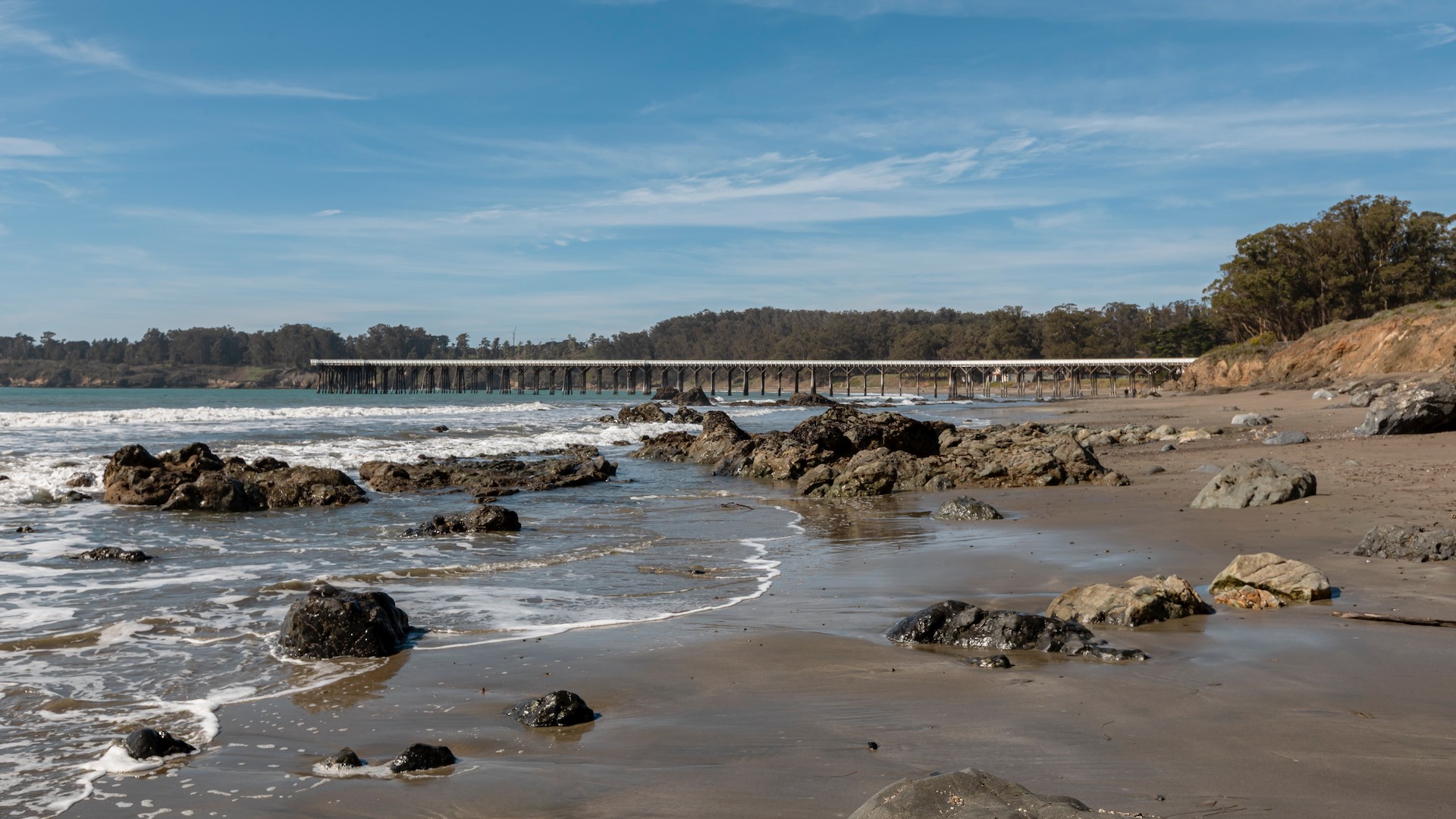
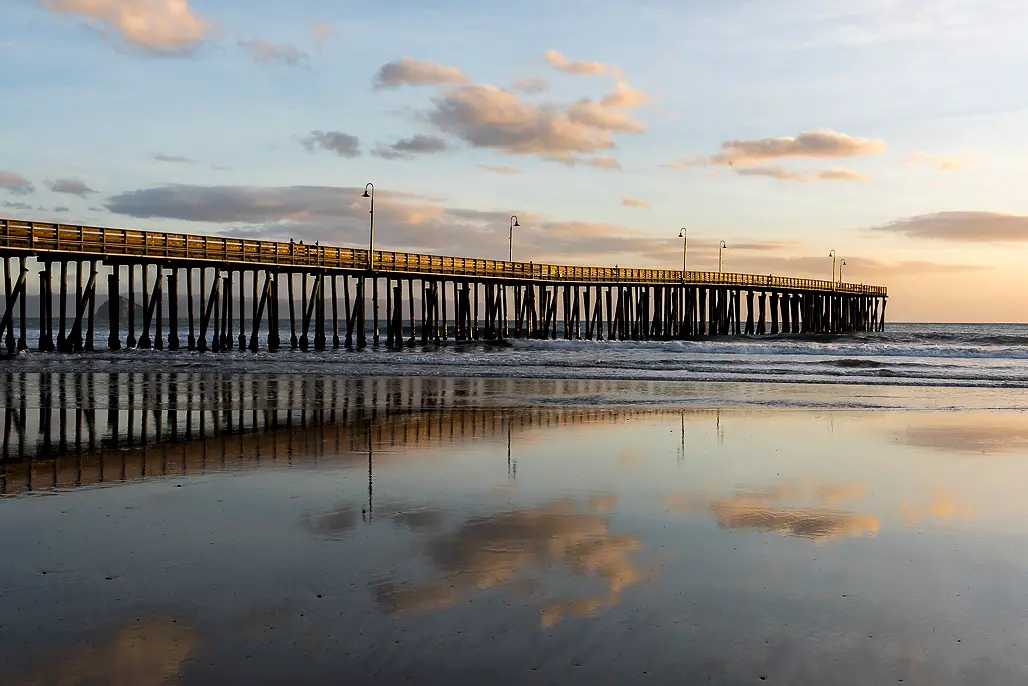
By 1878, the whaling industry had declined. Without sufficient employment, the village began to disappear. The general store was moved on horse-drawn skids to its present site, which became the new location of the village of San Simeon. At the same time, Senator Hearst had a new wharf constructed. The new wharf extended 1000 feet into the water that was deep enough to handle the largest ships of the time. Rails were laid on the pier to allow flat cars to move cargo to and from the new warehouse on shore. The pier handled shipments for the quicksilver (mercury) mines in the area. From 1919, all of the building materials for the Hearst Castle and other buildings on the Hearst estate were landed at the pier. William Randolph Hearst, son of Senator George Hearst, to house material and goods, which were to be taken later to the castle, built other warehouses near the pier.

In 1878 a first-class hotel, the Bay View, was built in San Simeon and a stage line had been established to Cambria. A telegraph line was constructed and provided a direct line to San Luis Obispo. In 1914, Manual Sebastian purchased the general store, and today it is still owned by the Sebastian family. Few buildings can boast of having been visited by persons inso many walks of life. Patrons have included: whalers, miners, ranchers, cowboys, politicians, movie stars, tourists, and well-known personalities such as Thomas A. Edison, Calvin Coolidge, and Winston Churchill. The general store housed the first post office in San Simeon until 1905, when it was moved onto the pier. In 1945, it was again located in Sebastian's store where it remains today.

The economy of San Simeon was enhanced by the patronage of William Randolph Hearst and his ranch hands. Spanish-style homes were built along the shore for Hearst employees. In 1874 the federal government built a lighthouse at Piedras Blancas. The general store and the government's lighthouse are the only exemptions to Hearst ownership for miles around. The Hearst ownership of the coastline has served to protect and preserve the coastline in its primitive state.
When California Scenic Highway 1 was completed, it served to open the majesty of San Simeon to travelers from around the world.

Following the death of William Randolph Hearst in 1951, the Hearst family donated a plot of land on the beach to be used as a day facility and to be called William Randolph Hearst Memorial Park. It became very popular and gradually grew into an overnight park. In 1957, the County of San Luis Obispo with the aid of the community of San Simeon constructed a pleasure pier. In 1969, the County and the State Department of Fish and Game Wildlife Conservation Board extended the pier about 300 feet. The State Department of Parks and Beaches took over the operation of Hearst Memorial Park in 1971, and it was again used as a day facility. In 1932, Sam Simeon State Beach, seven miles south of the Hearst Castle, was opened as a day use facility. In 1964, it was converted into a seaside overnight park.

In 1958, the Hearst Corporation gave the castle to the State of California, as a State Historical Monument. Today the "Hearst Castle" is visited by over a million visitors each year. The art treasures housed in the castle are priceless and worthy of the finest museum. In the late 1950's, a half-mile section of coastline six miles south of Hearst Castle was developed as a visitor-serving community for the guest of Hearst Castle.

The village of San Simeon, with its interesting past, its historic store, and its picturesque tile-roofed homes remains dignified and reserved.

MONARCH BUTTERFLY
One of nature's greatest mysteries is the annual migration of the Monarch Butterfly. The yearly trek brings monarchs from all over the western United States to various wintering destinations along the California coast. San Simeon is one of those breeding areas. The monarch travels distances up to 1,000 miles during it's migration. While in their wintering areas, the butterflies breed and bask in the warm sun. They are primarily found resting on eucalyptus trees. Their only diet is nectar, especially from milkweed, and water. These butterflies have never been to the wintering areas before and yet they return to the same areas one at a time every year.

WHALE WATCHING
Every year San Simeon hosts one of nature's grandest creations, the migrating Grey Whale. From the icy water of Alaska the Grey Whale migrates south from late December to early February to its breeding ground in the warm waters of Baja California in Mexico. After three months of breeding, the cows with their calves can be seen from the beach as they return north during March and April.


San Simeon Chamber of Commerce
Plaza del Cavalier, San Simeon, Ca 93452 (805) 927-3500


"Hearst Castle", "Hearst San Simeon State Historical Monument", "La Cuesta Encantada",
and "The Enchanted Hill" are registered trademarks of Hearst Castle®/California State Parks.
©2001-2009 California State Parks, All rights reserved.


  Gift Shop  
  Museum Shop  
  Food Concessions  
  Current Exhibits  
  Ticket
Information
 
  The Bus Route  


  Accommodations  
  Map/Directions  
  Transportation  
  State Parks  
  Camping  
  Weather  
  Monterey Bay Sanctuary  
  Elephant Seals  


California State Parks manages more than 270 park units.