

|
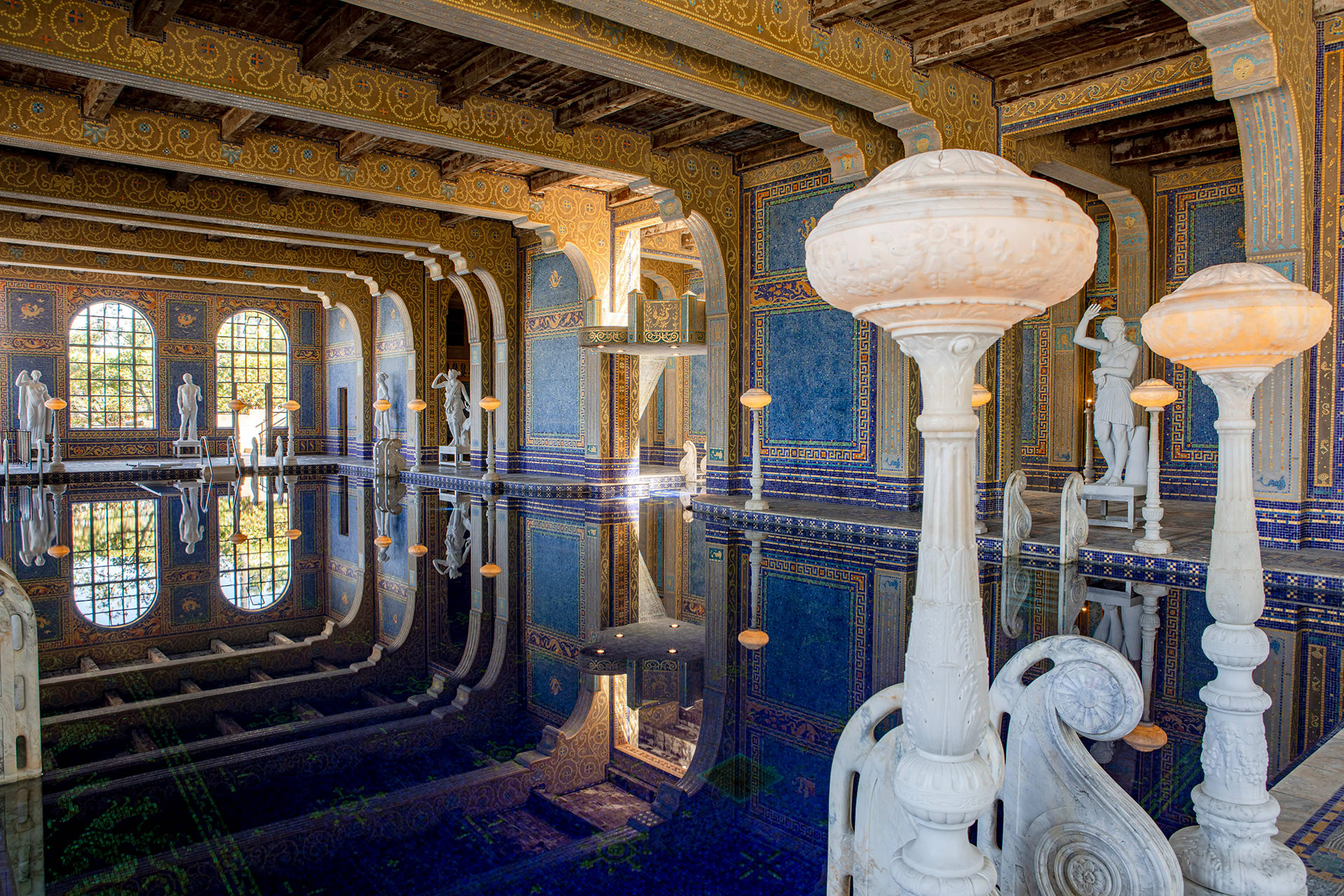
The Roman Pool at Hearst Castle
is the last stop on all of the guided tours.
The pool appears to be styled
after an ancient Roman bath such as the Baths of Caracalla
in Rome c. 211-17 AD. The mosaic tiled patterns were inspired
by mosaics found in the 5th Century Mausoleum of Galla Placidia
in Ravenna, Italy. They are also representative of traditional
marine monster themes that can be found in ancient Roman
baths. The statues are rough copies of ancient Greek and
Roman statues. One such copy represents the "Apoxyomenos."
Statuary was used on a considerable scale in the Baths of
Caracalla.
The pool and surrounding room, which were built from 1927-1934,
can be compared to an ancient Roman bath. The pool, like
the baths, is located indoors. Its water was heated as in
a tepidarium. However, in Hearst's complex there were no
hot or cold baths as there were in the ancient complex.
The Roman Pool complex was designed to contain an exercise
room, sweat baths, a handball court and dressing rooms.
The
Roman Pool is decorated from ceiling to floor with 1" square
mosaic tiles. These glass tiles, called smalti, are either
colored (mainly blue or orange) or are clear with fused
gold inside. The intense colors and shimmering gold of the
tiles combine to create a breathtaking effect. The designs
created by the tiles were developed by muralist Camille
Solon. The inspiration for some of these designs came from
the 5th Century Mausoleum of Galla Placidia.
Hearst was affected by the beauty of the mosaics in the
mausoleum and incorporated similar styles into his Roman
Pool. The walls of the mausoleum are marble but the vaulted
arches are composed of blue and gold smalti. The roofs and
dome are covered with mosaics of night blue, powdered with
stars. The Roman Pool is similar to the mausoleum with its
blue and gold color scheme and stylized star patterns. It
differs because marble was only used in the statues, not
on the walls, and their are no religious murals.
Decorating
the Roman Pool are eight marble statues. These statues were
carved starting in 1930 by Carlo Freter working in Pietrasanta,
Italy. They are rough copies of ancient Greek and Roman
statues. The statue of "Apoxyomenos" is found near the east
side of the building. "Apoxyomenos," also known as "The
Scraper," is a statue of an athlete scraping dirt and moisture
off the underside of his right arm. The original bronze
statue was created by the Greek sculptor Lysippos in 320
BC. Because Lysippos' work does not survive, Freter worked
from an ancient Roman copy of "The Scraper" found in the
Vatican museum in Rome. Freter faithfully copied the Roman
copy but also completes the statue with the addition of
the missing stirgil (scraper) and the missing fingers of
the outstretched hand.
|
"Hearst Castle", "Hearst San Simeon State Historical Monument", "La Cuesta Encantada",
and "The Enchanted Hill" are registered trademarks of Hearst Castle®/California State Parks.
©2001, 2002, 2003, 2004, 2005, 2006, 2007 California State Parks, All rights reserved.
|