
The Pools of
Hearst Castle
Neptune Pool
Construction for the Neptune Pool spanned 1924-1936.
Three swimming pools were built on this site,
each successively larger. Initial plans for the
site called for a "Temple Garden" with an ornamental
pool and temple structure. On March 31, 1924,
W.R. Hearst wrote in a letter to Julia Morgan,
"I am sending back the plan of the temple garden
with the suggestion that we make the pool longer
than it is, as long as a swimming pool. Mrs. Hearst
and the children are extremely anxious to have
a swimming pool!" On June 17, 1924, Morgan wrote
that the first swimming pool was nearing completion:
"Mr. Neptune and the two ladies can be placed
but the finished basins will take some time yet."
The second version of the pool, a substantial
enlargement, was created in 1926-1927. This version
had a series of concrete steps at the southern
side called the Cascade, down which water flowed.
The Neptune and Nereid statues, presently in the
temple pediment, then stood at the top of the
Cascade. The dressing rooms were begun in 1928
and furnished according to Hearst's instruction.
The present version of the pool was under construction
from 1934-1936. It is unlikely that the enlargement
was done to make it closer to Olympic size, as
has sometimes been conjectured; Olympic pools
are 165 feet long. It is more likely that the
colonnades and Cassou statues, which were planned
from the late 1920's, required an enlarged treatment.
Morgan anticipated further modifications of the
pool for Cassou's Neptune statuary group to be
placed in the small upper pool. On July 27, 1936,
Morgan wrote in a letter to Charles Cassou, "enclosed
is a plan and some photographs of the 'Neptune
Pool' in its present (uncompleted) state. The
recess of the main pool and the small pool above
to receive your 'Neptune' group I have not touched
since my visit with you last year - so please
do not think of them except as something yet to
be done to form a proper background and sitting
for your 'Venus' as well as your 'Neptune' statuary."
The "Neptune" sculpture group by Cassou intended
for the small upper pool was never installed.
The final version of the pool as it stands at
the Castle today is 104 feet long, 58 feet wide
and 95 feet wide at alcove. It is 3.5 feet deep
at the west end, 10 feet at drains and holds 345,000
gallons of water. Other unique aspects of the
Neptune Pool include the oil burning heating system,
the light-veined Vermont marble decorating the
pools and colonnades, and four 17-century Italian
bas-reliefs on the sides of the colonnades.
Roman Pool
The
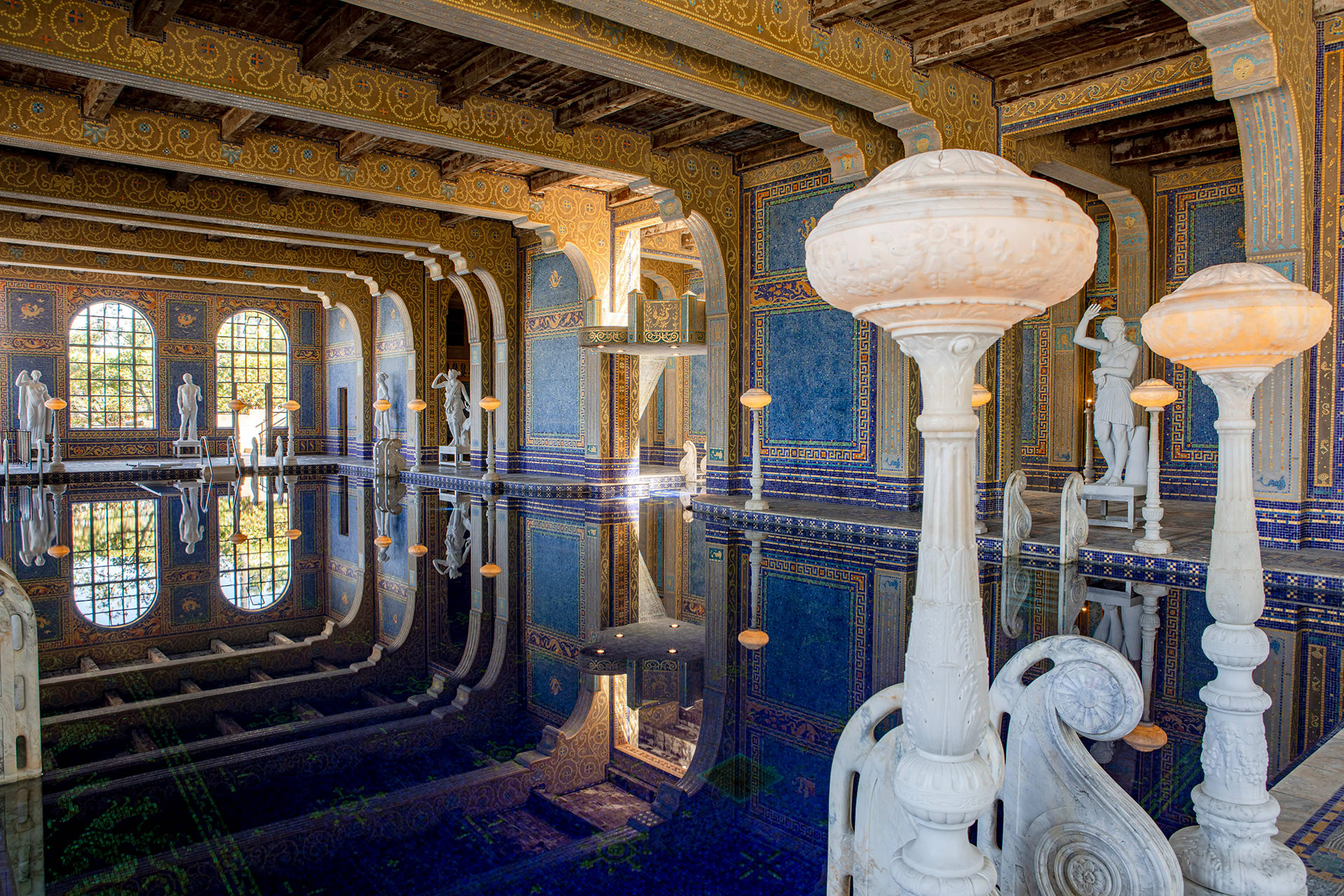
Roman Pool at Hearst castle is a tiled indoor
pool decorated with eight statues of Roman gods,
goddesses and heroes. The pool appears to be styled
after an ancient Roman bath such as the Baths
of Caracalla in Rome c. 211-17 CE. The mosaic
tiled patterns were inspired by mosaics found
in the 5th Century Mausoleum of Galla Placidia
in Ravenna, Italy. They are also representative
of traditional marine monster themes that can
be found in ancient Roman baths. The statues are
rough copies of ancient Greek and Roman statues.
One such copy represents the "Apoxyomenos." Statuary
was used on a considerable scale in the Baths
of Caracalla.
The pool and surrounding room, which were built
from 1927-1934, can be compared to an ancient
Roman bath. The pool, like the baths, is located
indoors. Its water was heated as in a tepidarium.
However, in Hearst's complex there were no hot
or cold baths as there were in the ancient complex.
The Roman Pool complex was designed to contain
an exercise room, sweat baths, a handball court
and dressing rooms.
The Roman Pool is decorated from ceiling to floor
with 1" square mosaic tiles. These glass tiles,
called smalti, are either colored (mainly blue
or orange) or are clear with fused gold inside.
The intense colors and shimmering gold of the
tiles combine to create a breathtaking effect.
The designs created by the tiles were developed
by muralist Camille Solon. The inspiration for
some of these designs came from the 5th Century
Mausoleum of Galla Placidia.
Hearst was affected by the beauty of the mosaics
in the mausoleum and incorporated similar styles
into his Roman Pool. The walls of the mausoleum
are marble but the vaulted arches are composed
of blue and gold smalti. The roofs and dome are
covered with mosaics of night blue, powdered with
stars. The Roman Pool is similar to the mausoleum
with its blue and gold color scheme and stylized
star patterns. It differs because marble was only
used in the statues, not on the walls, and there
are no religious murals.
Decorating the Roman Pool are eight marble statues.
These statues were carved starting in 1930 by
Carlo Freter working in Pietrasanta, Italy. They
are rough copies of ancient Greek and Roman statues.
The statue of "Apoxyomenos" is found near the
east side of the building. "Apoxyomenos," also
known as "The Scraper," is a statue of an athlete
scraping dirt and moisture off the underside of
his right arm. The original bronze statue was
created by the Greek sculptor Lysippos c. 320
B.C.E. Because Lysippos' work does not survive,
Freter worked from an ancient Roman copy of "The
Scraper" found in the Vatican museum in Rome.
Freter faithfully copied the Roman copy but also
completes the statue with the addition of the
missing strigil (scraper) and the missing fingers
of the outstretched hand. |
"Hearst Castle", "Hearst San Simeon State Historical Monument", "La Cuesta Encantada",
and "The Enchanted Hill" are registered trademarks of Hearst Castle®/California State Parks.
©2001, 2002, 2003, 2004, 2005, 2006, 2007 California State Parks, All rights reserved.
|