
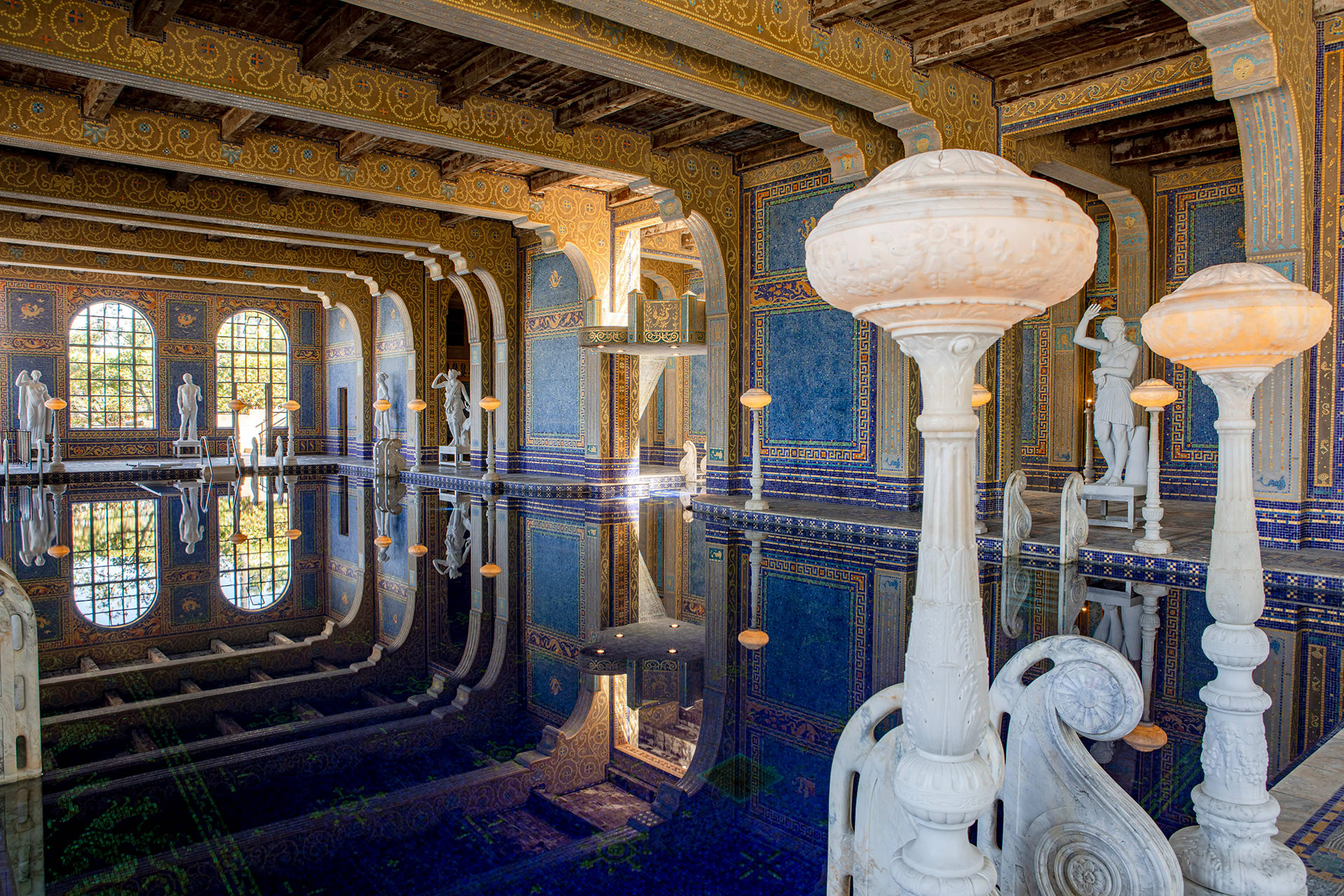
La Cuesta Encantada wasn’t just William Randolph Hearst’s beloved hilltop retreat. It was also a living museum that showcased his superb European and Mediterranean Hearst Castle art collection, which can still be seen today occupying almost every inch of this historic Californian castle. Browse through selected works below, before visiting the Castle to see the museum-worthy works for yourself:
The Three Graces
This white marble statue is a copy of a famous neoclassical sculpture by the Italian artist Antonio Canova (1757-1822). Canova created two versions of The Three Graces in the early 1800s. The original statue was sculpted for Empress Josephine and it is now part of the collection at The State Hermitage Museum in St. Petersburg, Russia. The second version was commissioned by the sixth Duke of Bedford, John Russell, and it was originally installed at the [...]
Explore The Three Graces
Neptune
Many of the paintings collected by William Randolph Hearst feature religious or mythological scenes. This one was painted in the 17th Century by French artist Simon Vouet, and depicts the sea god, Neptune. It is installed as a ceiling painting in one of Casa Grande’s south duplexes.
Explore Neptune
Two Sekhmet Figures and Two Sekhmet Heads
These four pieces of art date from the New Kingdom. Sekhmet literally translates as “the powerful.” Depicted with the body of a woman and the head of a lioness, she was the bloodthirsty protector of Ra, the sun god. Egyptian. Head on the left, 18th Dynasty; three others, 19th Dynasty. Granite Full figure with vein of feldspar, 5’10-1/2 x 20-1/2″ (179.1×52.1cm); 3/4 figure, 45-1/4 x 17-3/4″(114.9×45.1cm); chipped head, 19 x 19″(48.3 x 48.3cm); head with sundisk, [...]
Explore Two Sekhmet Figures and Two Sekhmet Heads
Marriage Chest
Spanish, late 15th – early 16th century. The interior side is painted by an unknown artist with a scene of St. Peter meeting Christ on the road to Rome. A front panel opens to reveal drawers decorated with gilded Gothic patterns
Explore Marriage Chest
The Continence of Scipio
Giulio Romano. (after designs by) The Continence of Scipio. Brussels, c. 1550. Tapestry. This scene shows Roman General Scipio Africanus returning a captive woman to her fiance and family.
Explore The Continence of Scipio
Ceiling in Casa Del Monte
While a number of ceilings on the estate are antique, others were custom-made by craftsmen during William Randolp Hearst’s era. This ceiling in Casa del Monte (House B) guest house is handpainted and decorated with 22 carat gold leaf. It features Classical design elements, but also includes a few local references: the words “San Simeon” and eucalyptes leaves.
Explore Ceiling in Casa Del Monte
Tiffany & Co. “Orchid Vase” Lamp
The base of this silver lamp was created in 1889 by Tiffany & Co. as the “Orchid Vase,” part of the company’s award-winning display at the Paris Universal Exposition. It was purchased by William Randolph Hearst’s mother, Phoebe Hearst, in 1889 and was converted to a lamp in 1891. Covered with realistic enamel orchids, the lamp was first displayed in Mrs. Hearst’s Washington D.C. home. After inheriting the lamp. William Randolph Hearst gave it pride of [...]
Explore Tiffany & Co. “Orchid Vase” Lamp
Nine Muses Sarcophagus
Marble Roman 3rd Century A.D. (about 230 A.D.) Sarcophagus with nine Muses, Apollo, and Athena on front; Ulysses listening to the Sirens on sides. Nine Muses: Goddesses of creative inspiration in poetry, song and other arts; the companions of Apollo. Daughters of Jupiter. Left to Right Polyhymnia (sacred hymns) Euterpe (lyric poetry) Thalia (comedy) Melpomene (tragedy) Erato (love poetry) Deceased as Apollo (sun god) Athena or Minerva (goddess of wisdom) Calliope (epic poetry) Terpsichore (dance and [...]
Explore Nine Muses Sarcophagus
Mosaic
This third century Roman mosaic depicts a merman and sea-life. It served as the floor of the main entrance into Casa Grande.
Explore Mosaic
The Virgin Mary as a Young Girl
This sweet wooden sculpture came from Spain and was likely created sometime around 1630-80 (although the date is debatable). It was first polychromed in classic estofado, a technique that starts with gold leaf covered by a layer of paint, then designs are etched through the paint to reveal the gold underneath. Although the statue was repainted in the new fashion of flowered white polychrome, the rich gold of the older estofado is still apparent in several [...]
Explore The Virgin Mary as a Young Girl
Wellhead
There are several wellheads scattered in the Hearst Castle gardens. These are structures that once were placed over a water well. This one is marble and has been fitted as a fountain. Its origin and date are not known. It is Renaissance in style and might be Italian, 16th century. At one time it was in the JP Morgan collection.
Explore Wellhead
Sixteenth-Century Limestone Bas-Relief
A sixteenth-century limestone bas-relief depicting St. Paul, mounted on the entrance facade of Casa Grande.
Explore Sixteenth-Century Limestone Bas-Relief
Berdago. Harlequin Lamp.
Austrian, early 20th century. Bronze, enamel, ivory, onyx. The boldly sweeping bronze figure of this dance provides a contrasting setting for the delicately carved ivory face.
Explore Berdago. Harlequin Lamp.